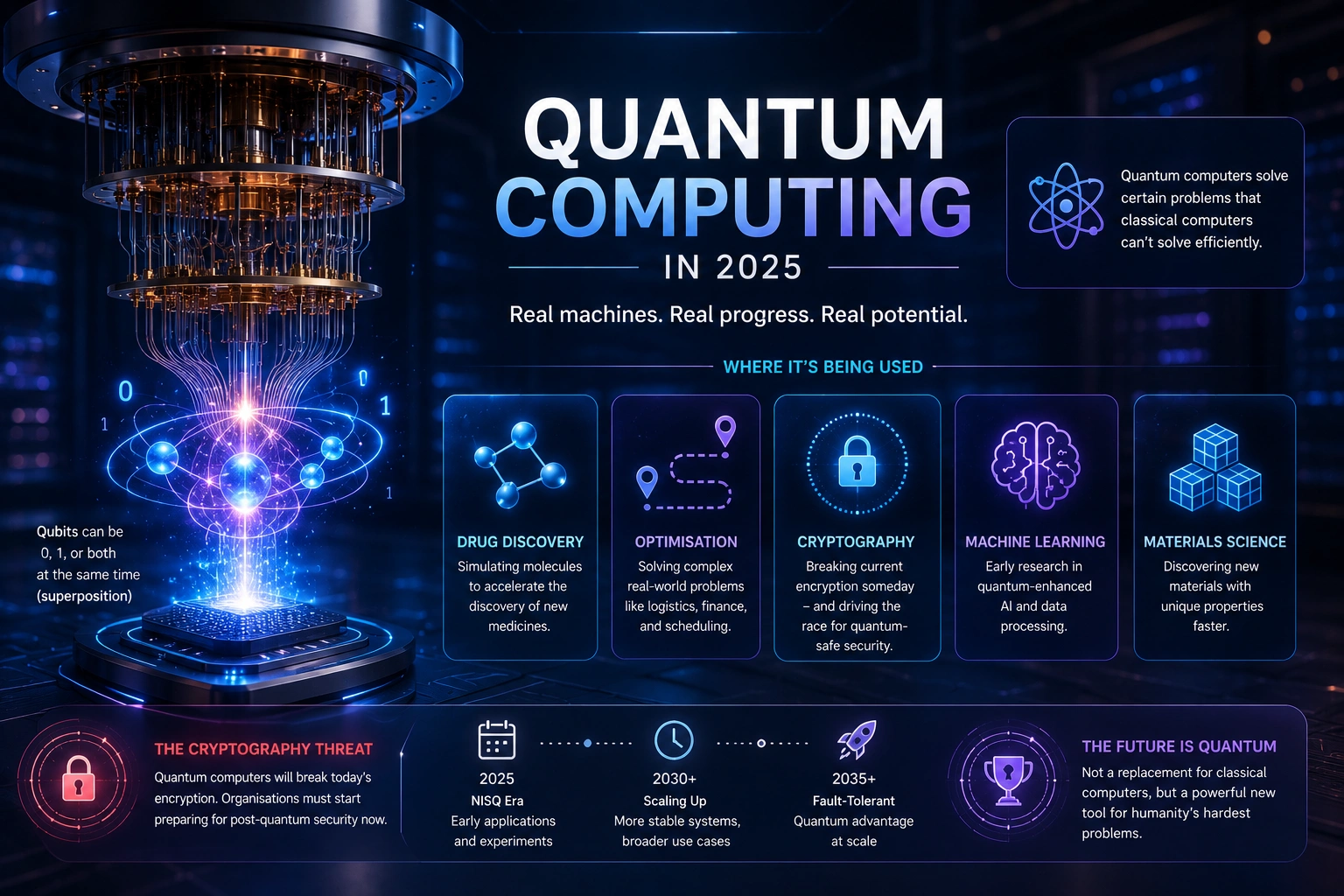
Quantum computing has been "the next big thing" for so long that many people have started to assume it's all hype. It isn't. In 2025, quantum computers are real, working machines that are beginning to solve specific problems that classical computers can't tackle efficiently.
The Core Idea, Without the Jargon
A classical computer processes information as bits — each bit is either 0 or 1. A quantum computer uses quantum bits (qubits) which can be 0, 1, or any combination of both simultaneously. This property — superposition — allows quantum computers to explore many possible solutions to a problem at the same time.
Where Quantum Computing Is in 2025
- IBM has operational quantum processors with over 1,000 qubits and offers cloud access through IBM Quantum.
- Google demonstrated "quantum supremacy" in 2019 and continues advancing toward error-corrected quantum computing.
- Microsoft is pursuing topological qubits for more stable quantum computation.
The honest assessment: we are in the "NISQ era" (Noisy Intermediate-Scale Quantum). Current quantum computers are too noisy and error-prone to achieve the full theoretical advantage. Practical, fault-tolerant quantum computing is still years away.
What Quantum Computers Are Actually Being Used For
Drug Discovery and Molecular Simulation
Simulating how molecules interact is computationally intractable for classical computers at scale. Pharmaceutical companies including Roche, Pfizer, and AstraZeneca are actively exploring quantum simulation for drug discovery.
The Cryptography Threat
Shor's algorithm, running on a sufficiently powerful quantum computer, can break RSA and ECC encryption — the standards securing essentially all internet communication today. NIST has already standardised post-quantum cryptographic algorithms. The internet is slowly beginning the process of upgrading its cryptographic foundations.
Conclusion
Quantum computing is real, advancing, and already being used for specific problems. The near-term implications — particularly for cryptography — are more urgent than most people realise. The long-term implications — for drug discovery, materials science, and optimisation — are genuinely profound.
Found this helpful?
Share on X