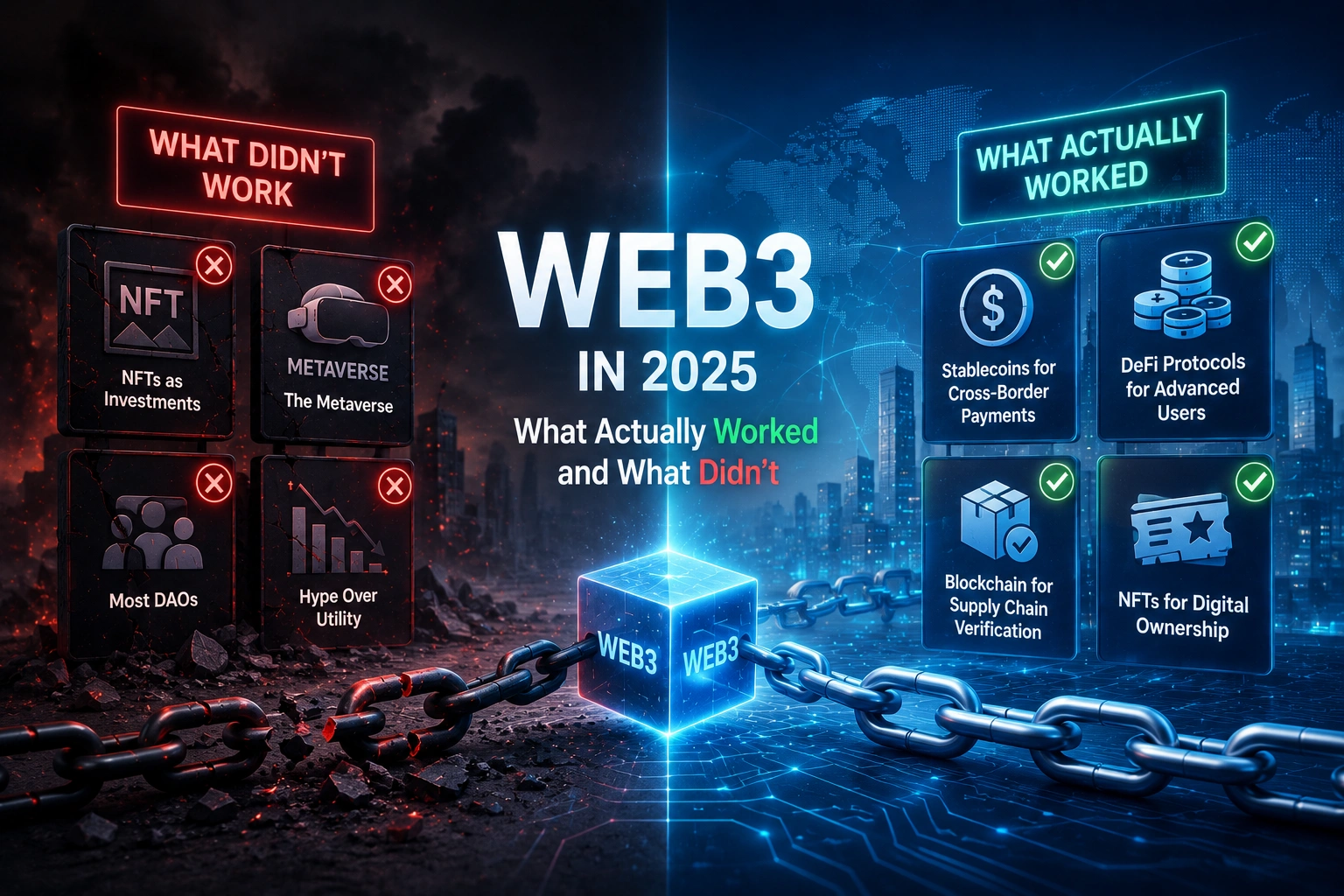
Web3 was the most hyped technology of 2021 and 2022. NFTs were selling for millions, DAOs were going to replace corporations, and the metaverse was supposed to be where we'd all work by 2025. The crash of 2022 wiped out most of that value. Now, three years on, the dust has settled enough to separate what actually worked from what was pure speculation.
What Didn't Work (Mostly)
NFT Art and Collectibles as Investment
The NFT art market collapsed by over 95% from its peak. The fundamental problem was that digital scarcity is artificial. The value was speculative, not intrinsic, and when speculation dried up, so did the market.
The Metaverse
Meta spent $46 billion building Horizon Worlds. Peak daily active users were in the tens of thousands. People don't want to strap on a headset to attend a virtual meeting when a video call works fine.
What Actually Worked
Stablecoins for Cross-Border Payments
Stablecoins — particularly USDC and USDT — have become genuinely useful for international money transfers, especially in countries with unstable local currencies. In Argentina, Nigeria, and Turkey, dollar-denominated stablecoins provide a practical hedge against currency devaluation.
Blockchain for Supply Chain Verification
Walmart uses blockchain for food safety tracking. De Beers uses it for diamond provenance. Pharmaceutical companies use it to combat counterfeit drugs. Unglamorous, but genuinely useful.
The Honest Assessment
Web3's core insight — that decentralised systems can reduce the power of intermediaries — is correct and valuable. The problem was the timeline and the applications. Most 2021-era use cases were solutions looking for problems, turbocharged by easy money and speculative frenzy.
Conclusion
The technologies that survived the crash are the ones that solved a real problem better than existing alternatives. The filter that separates genuine breakthrough from hype cycle remains the same: does this solve a real problem better than what already exists?
Found this helpful?
Share on X